Sponsored by Vernier Software and Technology
125th AAPT National Meeting — Boise, ID
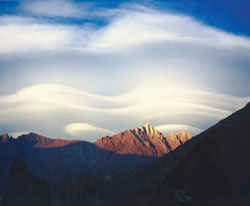
First Place
-
Natural Category
Title: Lee Waves
Student: Katarzyna Wegrzyn
School: La Jolla High School, La Jolla, CA
Teacher: Martin Teachworth
I took this picture while backpacking in the Sierra Nevadas in August 2001, looking east from Lake Italy just below Italy Pass. This extraordinary cloud formation is an example of phenomena called "mountain waves." These lee waves (mountain waves) are atmospheric internal gravity waves occurring on the lee side (the side opposite to the flow of wind) of topographical barriers when the wind flow is strong (25 knots or more) and roughly perpendicular to the mountain range. The structure of the barrier and the strength of the wind determine the amplitude and the type of the wave.
As the airflow proceeds across the mountain range, wind speed gradually increases, reaching a maximum near the summit. Proceeding downwind (5 to 10 miles from the summit), the airflow begins to ascend in a definite wave pattern. Additional waves, usually less intense than the first wave, may form downwind. These are similar to the series of ripples that form downstream from a submerged rock in a swiftly flowing river. As the air follows the contour of the lee side of the mountain, it begins to ascend and then seemingly roll under itself (while still moving downwind), forming the roll cloud (also called "rotor cloud") generally near the height of the mountain range. The lenticulars (lens-shaped clouds generally smooth in shape) generally form on the windward side and dissipate on the lee side of the wave.
This cloud phenomenon is comparable to water flowing over an obstruction causing velocity changes and lee waves.


