
Two-Year College New Faculty Training Experience
This program is not currently active, but we hope to continue it in the near future.

More Information:
The American Association of Physics Teachers presents an 18-month experience designed specifically for Two-Year College Physics Faculty in their first five years of teaching.
- Engaging
- Hands-On
- Proven at Two-Year Colleges
- Based on Physics Education Research
- Design for Promoting Active Learning
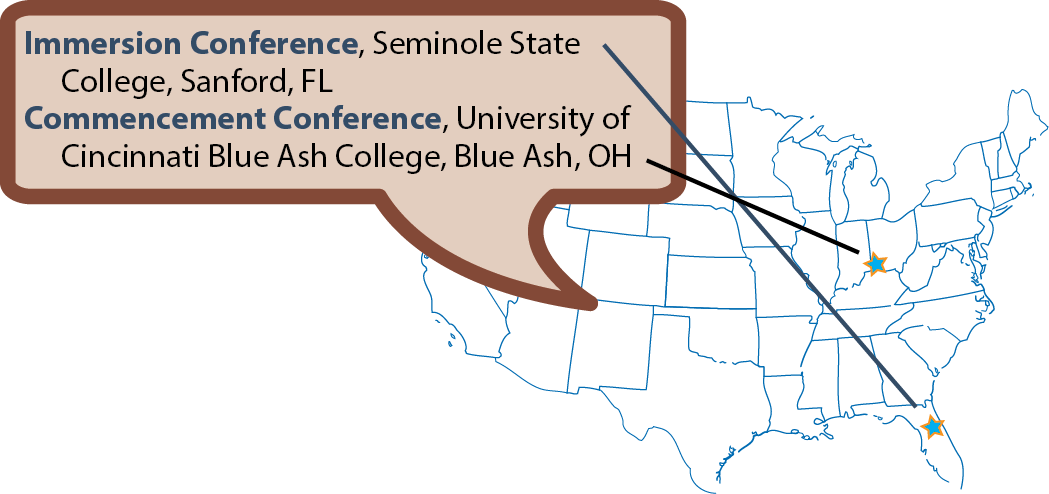
- Conferences, March 9-12, 2016
and July 21-23, 2017 - Online discussion sessions from
January 18, 2016 - July 2017
Overview
Timeline
| December 1, 2015 | Early notification of acceptance begins |
| December 28, 2015 | Application deadline |
| January 18, 2016 | Introduction to online system |
| January 25, 2016 - March 1, 2016 | Online discussions of seminal papers in Physics Education Research (PER) |
| March 9 - 12, 2016 | New Faculty Conference, Seminole State College, Sanford, FL |
| April 2016 - June 2017 | Implementation and mentoring of participants |
| July 21 - 23, 2017 |
New Faculty Commencement Conference, University of Cincinnati, Blue Ash College, Blue Ash, OH National AAPT Summer Meeting |
Leaders
- Scott Schultz - Delta College, University Center, MI
- Todd Leif - Cloud County Community, Concordia, KS
- Dwain Desbien - Estrella Mountain Community College, Avondale AZ
- Tom O'Kuma - Lee College, Baytown, TX
- Sherry Savrda - Seminole State College, Sanford, FL
- Robert Hilborn - American Association of Physics Teachers, College Park, MD
- Krista Wood - University of Cincinnati, Blue Ash College, Blue Ash, OH
Costs
- Room, you will be provided a room during the New Faculty Conferences to share with a participant of the same gender. We will try and accommodate requests for private rooms, but you will need to pay for half the room charges.
- All meals and snacks during the New Faculty Conferences will be provided on conference days, you will need to pay for meals on travel days. National Science Grants due not allow funds to be spent on alcoholic beverages.
- All workshop materials will be provided free of charge. Many participants find it useful to bring their own laptop computers, but this is not a requirement.
- The online discussion board accounts will be provided free of charge.
* There will be no registration fee for this experience.
Participant costs
- Home institutions are expected to cover one half of the travel expenses for participants to get to the two conferences. This includes airfare and meals on travel days. Scholarships will be available for participants whose home institution cannot use funds for out-of-state travel.
- The second conference will take place as a tandem meeting to the AAPT national summer meeting. As you are already there, we would highly encourage participants to stay an extra three days to participate in the national meeting. If you elect to stay, you or your home institution would need to cover the associated cost of staying which would include registration fee for the national meeting and the room and board for the extra days.
- Graduate credits for participating in this New Faculty Experience are available. If you wish to receive these credits, you will be responsible for paying the tuition. This will be optional.
Applying
Conferences: March 9 - 12, 2016 at Seminole State College, Sanford, FL and July 21 - 23, 2017 at University of Cincinnati, Blue Ash College, Blue Ash, OH
Simply fill out the application form (PDF) and send it to Scott Schultz (sfschult@delta.edu)
Why you should join in on the Experience:
This Experience is designed to equip new faculty members with knowledge of active learning techniques that are both  based on Physics Education Research (PER) and that have been successfully implemented at two-year colleges across the country. Led by experienced two-year college physics instructors, this conference will empower a new faculty member as they embark on the important mission of developing critical thinking skills in their students and developing the future technological workforce for this country.
This Experience will focus on Physics Education Research and the data that show traditional lecture-based physics classes result in relatively small gains in student conceptual understanding of the fundamental concepts of physics. Much of this will take place through an online discussion of journal articles related to the topic during June and July. Consequently, conference participants will be ready for the actual conference as they will understand why there is a need to engage students at a higher cognitive level.
This Experience exposes participants to three major pedagogical initiatives in introductory physics that have improved student comprehension: Microcomputer-Based Labs (MBL), Introductory College Physics/Twenty First Century (ICP/21), and Instructional Strategies in Introductory Physics (discourse management/TIPERS). Based on their exposure the first day, participants will choose two of these areas to further explore over the next two days.
Contact & Information
Need to know more? Contact Scott Schultz at sfschult@delta.edu
This program is supported by National Science Foundation grant #DUE-1225603 
 |