

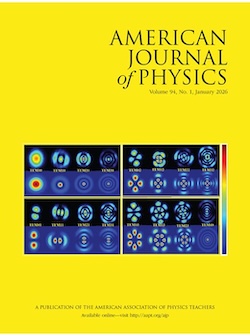
 January 2026
Volume 94, Issue No. 1
Laser beams in Fabry–Perot cavities with circular apertures
This study investigates the propagation of laser beams within Fabry–Perot resonators bounded by circular apertures. We present two independent analytical methods that can be shared with students for determining the transverse eigenmodes of such resonators, one based on the solution of the paraxial Helmholtz equation and the other employing the Huygens–Fresnel integral formulation. Complementing the theoretical analysis, we designed an undergraduate-level experiment using a half-symmetric plano-concave Fabry–Perot resonator. In this setup, Laguerre–Gaussian mode patterns were generated and compared with the theoretical predictions. The approach enhances students' understanding of resonator optics and fosters deeper engagement with experimental physics.
EDITORIAL
In this issue: January 2026 by John Essick; Jesse Kinder; Beth Parks; B. Cameron Reed; Keith Zengel. DOI: Am. J. Phys. 94, 5–6 (2026) https://doi.org/10.1119/5.0314499
AJP Reviewers. DOI: 10.1119/5.0314935
LETTERS TO THE EDITOR
A surprise to many physicists: Excel can handle complex numbers by Ole Anton Haugland. DOI: 10.1119/5.0305509
The CUBE virtual reality immersion by L. Estridge; J. Franklin. DOI: 10.1119/5.0313326
AWARDS
PhysTEC Teacher of the Year award talk: Cultivating a sense of belonging in the classroom by Lynn Jorgensen. DOI: 10.1119/5.0310402
Editor's Note: This paper is the text of a plenary talk given by the author at the AAPT Summer 2025 meeting in recognition of her award of PhysTEC Teacher of the Year.
PAPERS
Analyzing motion on a surface of revolution using the effective analogous potential energy function by Todd K. Timberlake; Hayden McGuire; Robert Mbenoun. DOI: 10.1119/5.0281493
Editor's Note: In dynamics problems where a particle is constrained to move on a surface of revolution that is symmetric about the vertical (z) axis, conservation of the z-component of angular momentum allows the problem to be reduced to a single radial dimension analogous to the way that central-force problems can be treated with an effective potential energy function. This paper develops a general “effective analogous potential energy function” for surface-of-revolution problems, and applies it to finding the condition for and stability of circular orbits for a variety of surfaces including general power law, conical, paraboloid, inverse-power, logarithmic, and hemispherical bowls. This can be a rich source of examples and exercises for students in advanced dynamics classes.
Resonant scattering and quasibound states with Airy functions by Thomas Neulinger. DOI: 10.1119/5.0285379
Editor's Note:Step functions and square wells are familiar to all students of quantum mechanics. Linear potentials and Airy functions are another common application of the Schrödinger equation. In this paper, the authors combine and extend these familiar models to include complex potentials. Analytic solutions and numerical studies reveal interesting scattering phenomena: absorption, resonant reflection, and quasibound states. An appendix on Airy functions and a supplementary Jupyter notebook make the article a self-contained unit appropriate for an advanced undergraduate or graduate course in quantum mechanics or math methods.
Density operators and quantum tomography for optimizing a Bell parameter measurement in the graduate laboratory by Alban Leschallier de Lisle; Melissa Kleine; Nicolas Ombredane; Sébastien Massenot; Renaud Mathevet; Benoit Chalopin. DOI: 10.1119/5.0280007
Editor's Note: Quantum state tomography, a well-established research tool, is a natural extension to investigations of Bell inequalities that are often performed in advanced undergraduate and graduate laboratories. Moreover, quantum state tomography provides valuable insight for students into the nature of the density matrix. This paper shows how students can perform these measurements and then use their results to understand and optimize the Bell-CHSH parameter.
From pixels to patterns: Decoding smartphone display properties through diffraction, reflection, and refraction by Mamatha Ramanjineyulu Maddur; Hemansh Shah; Praveen Pathak. DOI: 10.1119/5.0203616
Editor's Note: Are your students looking at their phones too much during class? These authors have a new solution to your problem: have them study the physical properties of their phone displays! By shining a laser pointer at their black screens, students can create diffraction patterns that reveal the pixel array structure and screen glass thickness. If they want to see their pixels in action, show them how to use a drop of water as a magnifying glass. These experiments are adaptable to all levels of undergraduate physics education.
Laser beams in Fabry–Perot cavities with circular apertures by Jian Zhao; Yuxin Zhai; Hanzhong Wu; Jing Li. DOI: 10.1119/5.0271827
Editor's Note: This paper provides both the theoretical background and the experimental design that are needed to create a laboratory exercise in which students explore the modes of a Fabry–Perot resonator bounded by circular apertures. It is appropriate for an advanced undergraduate laboratory intended for students who have already studied resonators in an optics course.
Recording holographic gratings in commercial photochromic sunglasses by M. J. Garicano Nuez; A. Shaw Angulo; P. Vaveliuk; O. Martínez-Matos. DOI: 10.1119/5.0292886
Editor's Note: This paper presents an affordable experiment that utilizes the photochromic polymer embedded in the lens of self-tinting sunglasses as a recording material for amplitude holographic gratings. In this approach, interference of blue light forms the grating by altering the recording material's local transparency through molecular excitation and the process is monitored by measuring the (non-exciting) red-light transparency. A concise theoretical background is given and applied both to the determination of important physical parameters and to the study of holographic grating behavior. The paper will be of interest to instructors preparing advanced laboratory experiments and independent projects for undergraduates, especially in specialized courses in optics.
NOTES AND DISCUSSIONS
Coulomb force between two Dirac monopoles by Alberto G. Rojo. DOI: 10.1119/5.0244845
Editor's Note: The concept of magnetic monopoles was proposed almost a century ago by Paul Dirac. While no such entity has been detected, it remains a powerful theoretical concept, as the existence of even a single magnetic monopole in the universe would explain the quantization of electric charge. To avoid violating Maxwell's equations, Dirac's model involved the concept of an infinitely thin string-like solenoid. This paper shows that such strings will interact with each other with an inverse-square Coulomb-like force; this is done by modeling the monopoles as semi-infinite lines of magnetic dipoles. This analysis shows how to apply fundamental concepts in electromagnetism and would be appropriate for students in an upper-level undergraduate course.
On the invariance of the spacetime interval by Marco Moriconi. DOI: 10.1119/5.0192469
Editor's Note: Graphical consideration of the spacetime interval between two events leads to a demonstration of its invariance, and once this invariance is demonstrated, then the Lorentz transformations follow. Instructors who wish to give students a geometric understanding of special relativity will want to use this approach.
Hearing a Green's function by Douglas A. Kurtze. DOI: 10.1119/5.0288905
Editor's Note: This very brief paper shares a lesson plan for introducing the Green's function using the example of a hand clap as an impulse that is localized in time and space with a propagation that is governed by a differential equation (the wave equation). Students' familiarity with how this sound propagates can be leveraged to help them understand the Green's function more generally.
Additional Resources
 |