

The Physics Teacher
October 2026
Volume 64 Issue 7
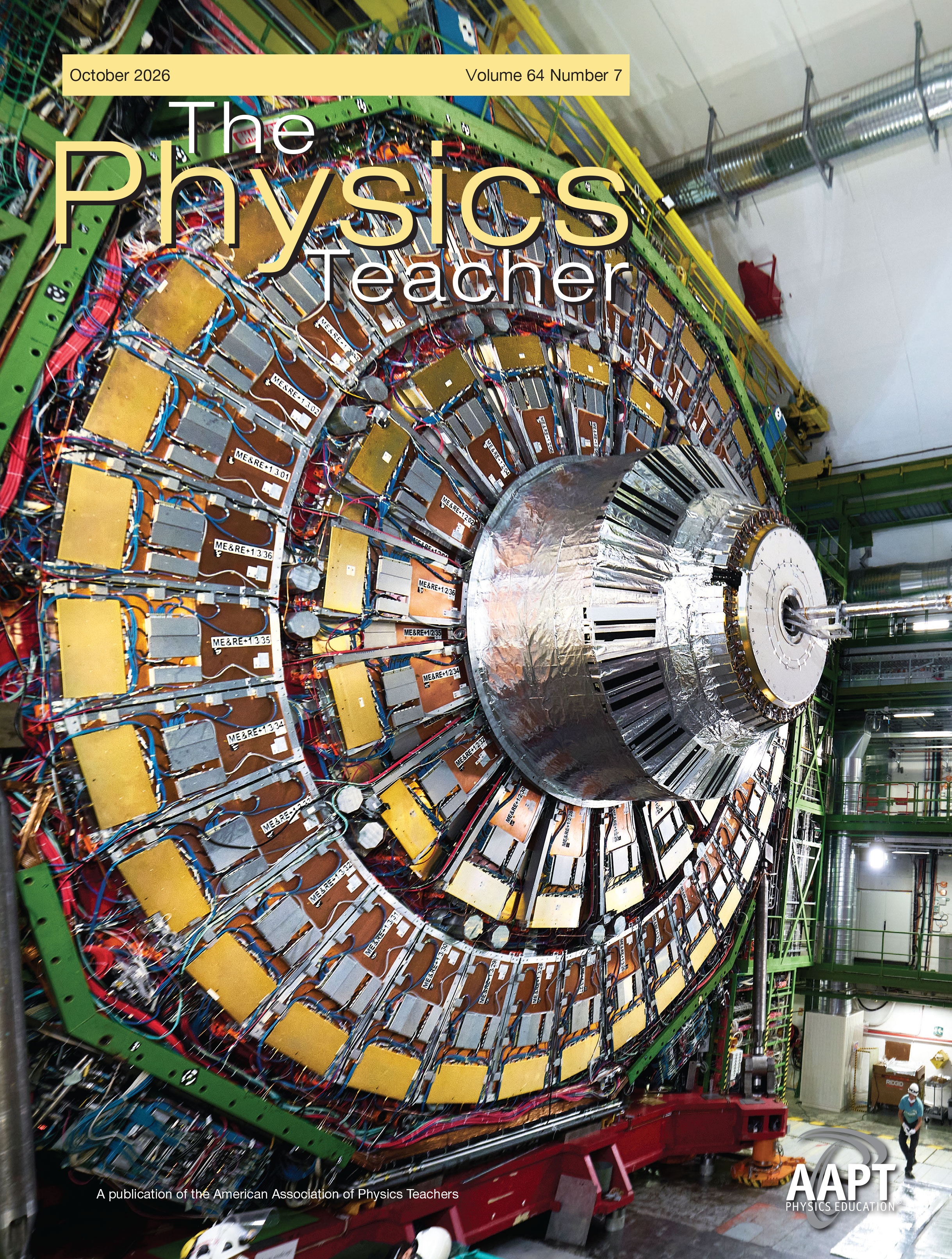
This Month’s Cover...shows the CMS detector (Compact Muon Solenoid) at CERN, one of four collision sites that make up the LHC (Large Hadron Collider); photo credit: CERN, Samuel Joseph Hertzog, Julien Marius Ordan. See “Did We Find the Real Higgs Boson?” by Don Lincoln to learn more about this detector’s role in establishing the existence of the Higgs particle. Note worker at bottom right for scale.
Columns
AI Physics Tools, And the Survey Says..., Astronotes, Fermi Questions, Figuring Physics, For the New Teacher, iPhysicsLabs, Just Physics, Little Gems, Physics Challenge for Teachers and Students, Talkin' Physics, Technology In The Classroom, Tricks of the Trade, TCY Tidbits, Visual Physics, and Websights.
LETTERS TO THE EDITOR
Teaching the physics of free fall by Good Energy; Paul Hewitt. DOI: 10.1119/10.0046719
Another proof of SHM’s isochronism byChiu-king Ng. DOI: 10.1119/5.0322294
Reply to Cross by Roberto De Luca; Marco Di Mauro; Adele Naddeo
The Physics Teacher 64, 445 (2026) https://doi.org/10.1119/5.0344381
PAPERS
Modeling Heat with Thermal Energy Charts by Ross Gunderson. DOI: 10.1119/5.0213134
Did We Find the Real Higgs Boson? by Don Lincoln. DOI: 10.1119/5.0352891
Demonstration that F = ma for an Extended Mass by Rod Cross. DOI: 10.1119/5.0273764
Triangles at the Speed of Light: The First Relativistic Drawing by Caio Barca Bragatto; Marcio Luis Ferreira Nascimento. DOI: 10.1119/5.0273730
Designing Questions to Elicit Students’ Mechanistic Explanations by Lisa M. Goodhew; Amy D. Robertson; Lauren C. Bauman. DOI: 10.1119/5.0238724
Developing Inquiry Experience Through Curiosity-Driven Open Inquiry by Freek Pols; Xandesh Perk; Amy Tarling. DOI: 10.1119/5.0220934
Solving the Puzzle of Nucleosynthesis by Sean M. O’Neill. DOI: 10.1119/5.0196007
Examining the Relationship Between High School Teachers’ Physics Identity and Disciplinary Preparation by Hulya Avci; Zahra Hazari. DOI: 10.1119/5.0270871
Vertical Projectile Motion Taking into Account the Wind by Peter Chudinov; Vladimir Eltyshev; Yuri Barykin. DOI: 10.1119/5.0257604
Analysis of the Path Length of a Projectile with Drag Force: From Theory to High School Classroom Practice by Qian-Qian Wu; Yuan-Ming Zhu. DOI: 10.1119/5.0262410
Tall Animals Are Endothermic: Height, Blood Pressure, and an Animal’s Thermal Regulation Mechanism by Scott A. Lee. DOI: 10.1119/5.0259930
Apparatus Named After our Academic Ancestors—VIII by Thomas B. Greenslade, Jr. DOI: 10.1119/5.0271042
Navigating Online Astronomy: A Guide to Success by Neda Naseri; Abdorreza Samarbakhsh. DOI: 10.1119/5.0256296
Motion Down an Incline and Galileo’s Postulate by Roger D. Rosenkrantz. DOI: 10.1119/5.0228541
RPG-Based Gamification in Teaching Modern Physics by Borbála Herendi; Szabolcs Varga; Péter Jenei. DOI: 10.1119/5.0251763
Piezoelectric Seismometer by Jiří Erhart; Vladimíra Erhartová. DOI: 10.1119/5.0270362
Hands-On Exploration of Electromagnetic Waves: Building a Wireless Telegraph and AM Radio Receiver by Carlos A Arredondo; Valentina Miranda Garcés; Liana Margarita Díaz Ortiz; Tatiana Murillo Mosquera; Daniel Camilo Lasso Castañeda; Jorge H. Quintero-Orozco. DOI: 10.1119/5.0258416
Teaching with Mixed Reality Physics Apps by Howard Winston; Diego Valente; Steven Binz. DOI: 10.1119/5.0214894
Accessibility for Deaf People: An Adaptation of the Parabolic Acoustic Mirror Demonstration by Juan Lucas Nachez; Erica Cristina Nogueira. DOI: 10.1119/5.0269505
Measuring g with Light Intensity Analysis of a Falling Paper Ladder: A Fun STEM Weekend Activity for Students by Menghan Wang; Yan Zhang; Yajun Wei. DOI: 10.1119/5.0278577
An Innovative Experiment to Verify the Properties of Simple Harmonic Motion Using Phyphox Software by Xianglong Shan; Zengze Liu. DOI: 10.1119/5.0274178
Multimeters by Thomas B. Greenslade, Jr. DOI: 10.1119/5.0278698
 |