

 March 2026
Volume 94, Issue No. 3
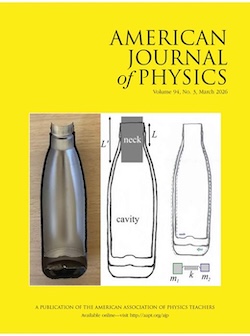
Two oscillators in the double-wall bottle
The double-walled water bottle demonstrates two distinct resonances. When held at the neck and struck on its side, it makes a low-pitched, long-lasting tone that is due to the inner and outer walls oscillating in opposite directions. A second distinct tone, the well-known Helmholtz resonance, can be excited by blowing across the neck or striking the base of the bottle with a soft mallet or heel of the hand. In a lab setting, students can use free audio software to determine the frequencies of these two resonances. These frequencies shift in opposite directions as students vary the amount of water in the bottle, and students may hear beating of the two frequencies when they cross. As a subject for a laboratory activity, the double-wall bottle illustrates the interplay between experimental data and theoretical models in a familiar object.
EDITORIAL
In this issue: March 2026 by Sathya Guruswamy; Jesse Kinder; Claire A. Marrache-Kikuchi; Beth Parks; Daniel Schumayer; Todd Springer; Keith Zengel. DOI: 10.1119/5.0325184
LETTERS TO THE EDITOR
Spacetime intervals as light rectangles: Comment on “On the invariance of the spacetime interval” [Am. J. Phys. 94, 68–71 (2026)] by Aleksandar Gjurchinovski. DOI: 10.1119/5.0319381
Reply to Aleksandar Gjurchinovski's comment by M. Moriconi. DOI: 10.1119/5.0323347
PAPERS
Using oral exams in physics and astronomy courses by Brian DiGiorgio Zanger. DOI: 10.1119/5.0276805
Editor's Note: Despite their historical popularity, in recent years undergraduate oral examinations have become less and less common in the United States. However, recent technological advances (especially the rise of generative artificial intelligence) are making it more difficult to maintain the academic integrity of in-class or take-home written exams. In response, many instructors are reconsidering the role of the oral exam in modern assessment. This article describes one author's experience and method for administering oral exams in upper-division undergraduate physics and astronomy courses, along with helpful discussion and resources for instructors. We hope this article serves as an inspiration for readers interested in exploring alternative assessment methods.
Exploring Fourier methods with beer bottles by David Kordahl; Emma Foster. DOI: 10.1119/5.0245272
Editor's Note: This article presents a simple acoustics experiment using beer bottles to explore Fourier methods and the physics of driven damped oscillators. The setup is simple: by recording the sound emitted by a speaker with and without a bottle in the vicinity, students can extract the system's Green's function using either pure tones or chirp excitations. Both methods demonstrate how Fourier analysis can be used to extract the resonance parameters with minimal equipment, making it ideal for undergraduate wave physics laboratories. The setup is inexpensive and analyzing the measurements also introduces signal processing and frequency-domain analysis. Plus, after performing these experiments, your students will always think of Green's functions when having a beer.
Two oscillators in the double-wall bottle by Daniel O. Ludwigsen; Alexandria Meade. DOI: 10.1119/5.0304544
Editor's Note: When you add water to a bottle, does its acoustic resonance shift to a higher or lower frequency? In the case of a double-walled water bottle, both answers are correct! The frequency of the Helmholtz resonance increases, but added water decreases the frequency of the structural resonance in which the concentric walls move in opposite directions. This behavior is the basis of a fun lab experiment that can teach students about modeling resonances while making good use of these ubiquitous bottles.
How physics got its right hand: The origins of chiral conventions in electromagnetism by Tyler McMaken. DOI: 10.1119/5.0282367
Editor's Note: Why is a positive angle measured counterclockwise? Why do we use right-handed coordinate systems in physics? Why is the Earth's geographic north pole a magnetic south pole? Who decided? When? In this article, the author explores the interesting history behind these seemingly arbitrary conventions, from fluxions and quaternions to vines and hops. The narrative provides more than interesting trivia—like how Ampere's “left-arm rule” evolved into today's “right-hand rule.” It also provides historical background for courses in electricity and magnetism and can inform classroom discussions about conventions, standards, and communication in science.
An instructive paradox in the method of images by Anupam Garg. DOI: 10.1119/5.0283441
Editor's Note: How do you calculate the dipole moment when using the method of images? This article demonstrates that two sensible approaches for a standard image charge problem yield conflicting results. Resolving the paradox provides insight into the multipole expansion and mathematical nuances that physicists often ignore. The examples here could enrich a junior-level electrodynamics course—or stump your colleagues in the physics department.
Interference rings by scattered light by Giuliano Malloci; Guido Pegna. DOI: 10.1119/5.0278586
Editor's Note: Optics instructors will want to try the demonstration described in this paper, which updates an often-overlooked geometry for illustrating both scattering and interference of light. The authors show how to simplify the analysis so that it is appropriate even for the introductory classroom.
Using quantum computers to simulate single-photon Mach–Zehnder interferometers by S. Kang; Z. He; S. Banerjee; J. K. Freericks. DOI: 10.1119/5.0268545
Editor's Note: If you want to simulate a quantum mechanics experiment, why not use a quantum computer? This paper gives instructions for simulating the Mach–Zehnder interferometer using the IBM Sherbrooke quantum computer and the Qiskit programming language. Even students in large classes who cannot be provided with the opportunity to perform hands-on experiments can instead perform their own simulations after a few lessons on modeling spins on quantum computers. This content could be incorporated into a course on quantum computing or into a quantum mechanics course at any level.
Introduction to machine learning in undergraduate physics by Shafat Mubin; Xavier Wellons. DOI: 10.1119/5.0243715
Editor's Note: You know AI and Machine Learning are important topics to teach your students, but you don't really know how to introduce these tools in your undergraduate physics curriculum? This paper provides you with a few examples, taken from the fields of mechanics and thermodynamics and requiring minimal programming expertise. Using Mathematica's built-in machine learning models, the authors demonstrate how these can be trained on numerical datasets, simulated trajectories, and even pictures to extract physical parameters. For instance, given the 2D trajectory of a projectile, a trained model is able to determine its drag coefficient. These examples illustrate how machine learning can (almost painlessly) be integrated into existing courses, providing students with hands-on experience in modern computational methods while deepening their physics understanding.
COMPUTATIONAL PHYSICS
Introduction to supervised machine learning for physics students by Jan Tobochnik; Harvey Gould. DOI: 10.1119/5.0285290
Editor's Note: For instructors who would like to give their students an introduction to how machine learning works “under the hood,” this paper discusses the simplest machine learning algorithm, logistic regression. It is applied to classify two types of physical systems: the Ising systems above and below the critical temperature, and motion due to different central forces. The paper also includes sample problems for students.
ADVANCED TOPICS
Introduction to higher-order classical dynamics: Pais–Uhlenbeck model and coupled oscillators by Cássius Anderson Miquele de Melo; Ivan Francisco de Souza. DOI: 10.1119/5.0284311
Editor's Note: Most classical mechanics textbooks include discussions of the Lagrangian and Hamiltonian formalisms. Few tell the reader what to do when their system depends on derivatives higher than second order. In this paper, the authors show how to handle such systems, with two examples. These examples have two delightful teaching uses. First, we see a new way to think about coupled oscillators. Second, we see how to think of complicated theoretical systems as coupled oscillators!
On the Bogoliubov–Valatin transformation for fermionic Hamiltonians without a linear part by Davide Bonaretti. DOI: 10.1119/5.0291967
Editor's Note: Many quantum-mechanical models use quadratic Hamiltonians; however, they are seldom in a diagonal form, hence one cannot easily read off the energy spectrum. The Bogoliubov–Valatin transformation is a canonical change of creation and annihilation operators that diagonalizes such Hamiltonians, thereby revealing the quasiparticle excitations of many-body systems. Although the technique often appears in widely used textbooks, the mathematical details or corner cases are omitted. The strength of the current article is that it discusses the construction of the transformation under minimal assumptions and also treats singular cases. It can provide valuable complementary material in graduate-level courses, and student problems can be constructed from examples.
The Poynting vector should be E×B/μ0 not E×H by Kirk T. McDonald. DOI: 10.1119/5.0297408
Editor's Note: This Note revisits Poynting's analysis of electromagnetic work, energy density, and energy flux in matter. While Poynting focused on the interaction between fields and free charges, the author argues that making the role of bound charges explicit sheds light on the Abraham–Minkowski controversy over the proper definition of electromagnetic momentum.
NOTES AND DISCUSSIONS
An alternative Lagrangian approach by Keith Zengel. DOI: 10.1119/5.0307168
Editor's Note: This paper makes use of a degree of freedom that you may not have known existed: the Lagrangian doesn't have to be T–U. Similar to the magnetic vector potential that can take alternative forms within gauge freedom, the Lagrangian can also vary by an additive term. Taking advantage of this freedom can allow the Lagrangian to be written as a perfect square, and the Euler–Lagrange equation becomes a first-order differential equation. This transformation is also linked to the generating function in Hamiltonian theory. Instructors in the advanced undergraduate mechanics course will enjoy this short paper.
Fixed-point iteration for numerical solutions to equations in physics: Comment on “Solving introductory physics problems recursively using iterated maps” [Am. J. Phys., 93, 336–343 (2025)] by J. J. Bissell. DOI: 10.1119/5.0274265
Editor's Note: A recently published article by English et al. illustrated the use of fixed-point iteration as a way to solve a classic introductory physics problem. This follow-up comment solves the same problem using alternative iterative maps with varying convergence properties, demonstrating the importance of experimenting with different schemes when solving problems iteratively. Readers interested in developing their undergraduates' numerical skills early on in the curriculum will find additional inspiration in this insightful complement to the original article.
BOOK REVIEWS
Soft matter: Concepts, Phenomena, and Applications by Suraj Shankar. DOI: 10.1119/5.0324450
Additional Resources
 |