

The Physics Teacher
January 2026
Volume 64 Issue 1
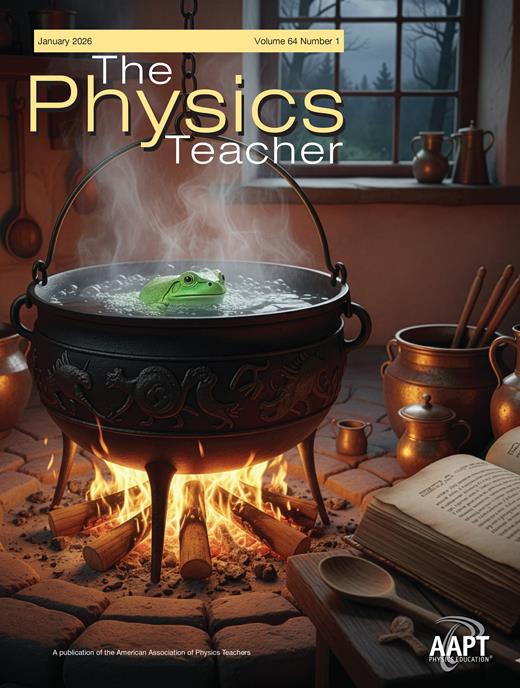
This Month's cover...was produced by Gemini, Google’s version of artificial intelligence (AI), using the prompt “generate me an image of a frog in a boiling pan using only items in the public domain.” For enlightening perspectives about AI’s impacts on physics instruction, see Gerd Kortemeyer’s article “The Boiling-Frog Problem of Physics Education”; also see the Call for Papers
Columns
AI Physics Tools, And the Survey Says..., Astronotes, Fermi Questions, Figuring Physics, For the New Teacher, iPhysicsLabs, Just Physics, Little Gems, Physics Challenge for Teachers and Students, Talkin' Physics, Technology In The Classroom, Tricks of the Trade, TCY Tidbits, Visual Physics, and Websights.
EDITORIAL
Call for Papers: AI and Ethics in Intro Physics by Gary White. DOI: 10.1119/10.0042150
LETTERS TO THE EDITOR
Comment on “Creating physics concept cartoons using ChatGPT” by Jianwei Jiang. DOI: 10.1119/5.0292020
Making high school physics interactive: Integrating AI tools to support active learning by Nasir Ilyas. DOI: 10.1119/5.0298555
Dollars and sense by Terrence Toepker0298555 Phys. Teach. 64, 4 (2026). DOI: 10.1119/5.0304752
PAPERS
The Boiling-Frog Problem of Physics Education by Gerd Kortemeyer. DOI: 10.1119/5.0296601
Surviving a Syrup Tsunami by Hollis Williams. DOI: 10.1119/5.0168972
Hawking for Beginners by Jorge Pinochet. DOI: 10.1119/5.0215599
Untapped Resources: Training Undergraduate Teaching Assistants as Future Physics Educators by Angela Johnson; Corey Payne. DOI: 10.1119/5.0177413
Using Skateboarding to Develop a Culturally Relevant Tutorial on Static Equilibrium by Gian Viray; Isaac Cheney; Tong Wan. DOI: 10.1119/5.0225558
Adaptation of a Calculus-Based Introductory Physics Lecture and Lab for a Blind Student by Abigail M. Bogdan; Kimberley A. Bassi-Cook. DOI: 10.1119/5.0192806
A Two-Session Qualitative and Quantitative Lab Experiment on Faraday’s Law for Introductory Physics Students by Scott M. Gianelli. DOI: 10.1119/5.0227048
Measurement of the Magnetic Energy Stored in an Inductor by Bogdan M. Leu. DOI: 10.1119/5.0221797
Using 3D Printing to Construct a Precise Spectrometer and Enhance Understanding of How It Works by Matej Pašák; Gezim Hodolli. DOI: 10.1119/5.0211303
Exploring Light Polarization Using Smartphone Screens and Dielectric Interface Reflectance by Daniel N. Hammer; Thiago M. Batistel; Cristiano M. B. Cordeiro. DOI: 10.1119/5.0204107
Demonstration of Resonance Using a Reciprocating Motor and Smartphones by Qiren Chen; Xiumei Feng; Min Xia; Jiabao Zhu. DOI: 10.1119/5.0203145
Study of an Impulsive Blow on an Unpivoted Uniform Metal Rod by Video Analysis by E. S. Silva; G. A. C. Perez; A. L. de Oliveira; V. L. B. de Jesus. DOI: 10.1119/5.0215881
A Viscosity Lab Designed to Demonstrate the Usefulness of Uncertainty Calculations by Mike Augspurger. DOI: 10.1119/5.0221975
A Black Balloon Dancing Under a Stream of Water by Edy Wibowo; Naily Ulya. DOI: 10.1119/5.0195532
Isochronism of the Harmonic Oscillator Revisited by Joseph A. Rizcallah; Yahya N. Shaar; Nibal S. Khassan. DOI: 10.1119/5.0228179
The Conservation and Transformation of Mechanical Energy to Thermal Energy: An Experiment and Its Use as a Teaching Tool for Physics Students by Nguyen Anh Thuan; Pham Kim Chung; Nguyen Thi Thu Hang. DOI: 10.1119/5.0197144
A Zero-Cost and Active Method for Estimation of the Speed of Sound Using a Smartphone for Undergraduate Classrooms by Manoj Kumar Gundawar. DOI: 10.1119/5.0230153
 |